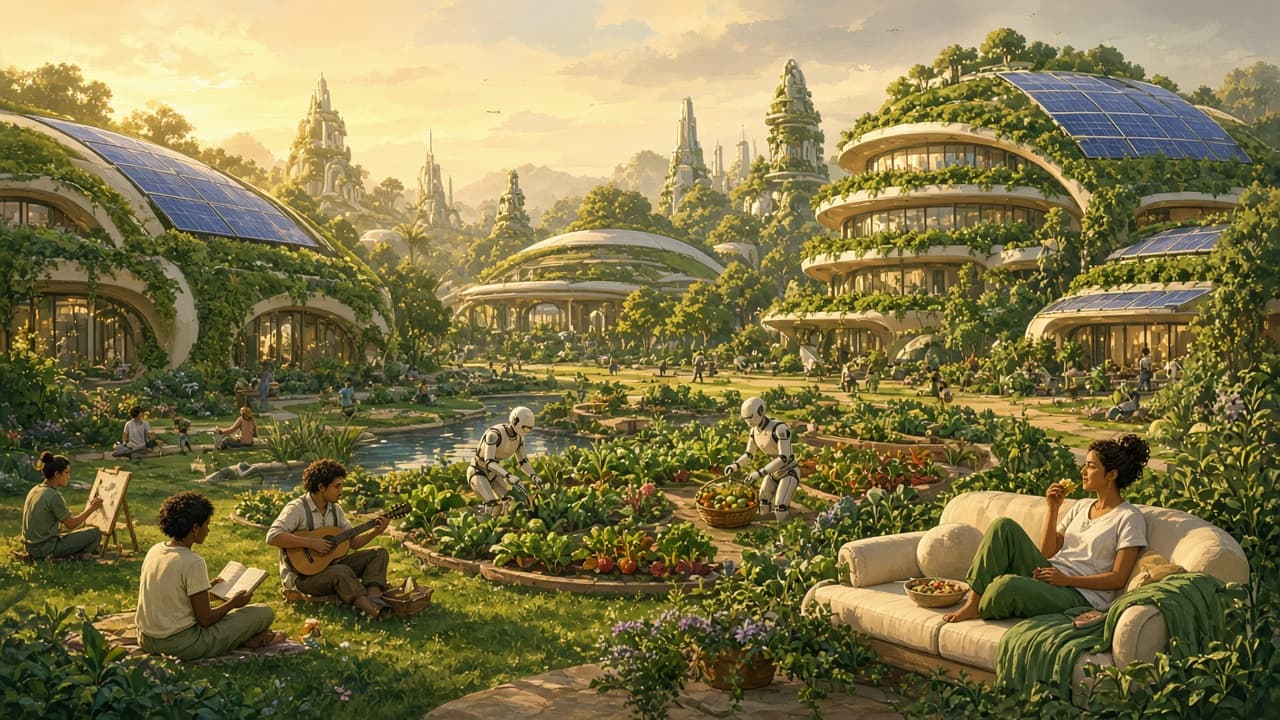
After Money: What's the Point of Being Human?
Every economic system ever invented is an answer to one question: who gets the stuff when there isn't enough stuff?
That's it. That's the whole field of economics. Capitalism, communism, feudalism, your office's unspoken rules about the last donut in the box. All of them are rationing algorithms. Different code, same problem.
So here's the fun part: what happens to the answer when the question disappears?
Thirteen years ago I wrote an essay called Abundance about the destination: a world where technology makes the essentials of a good life practically free. I still stand by most of it, which is a small miracle given that I also predicted things in other essays that aged like milk.
But I skipped a chapter. I wrote about the world before scarcity ends, and the world after, and hand-waved the part in the middle.
The middle is where we live now. So let's do the middle.
How we decide who gets stuff:
Start three steps before the interesting part, as always.
Imagine two kids and one cookie. Every possible solution to that problem is an economic system.
Split it in half: socialism.
Whoever grabs it first: markets, roughly.
The bigger kid takes it: feudalism, and also most of human history.
Mom decides: central planning.
Flip a coin: lottery.
Take turns: queueing.
The kid who did the dishes gets it: meritocracy.
Every civilization is just those kids scaled up by a billion, with better lawyers.
For most of history, the big kid took the cookie. Violence was the distribution system. Then we invented something genuinely clever: prices.
A price is a piece of information. It's the world's way of telling you how much everyone else wants the thing you want. When a billion people make choices, prices move, and resources flow toward whatever people value. No king required. It's a distributed computer made of humans, and it runs on scarcity.
That's the part nobody says out loud: capitalism isn't a belief system, it's a scarcity-management algorithm. And credit where it's due, it is the best one anyone has shipped. It took our species from candles to data centers in a few centuries.
But every algorithm has an input it assumes will always be there. This one assumes the stuff stays scarce.
The input is changing:
Some things have already quietly crossed over.
Information used to be scarce. A book cost a month's wages, so we rationed knowledge with money and with priests. Today you carry the accumulated knowledge of our species in your pocket and it costs nothing to copy. We didn't vote on making information free. The technology just made rationing it embarrassing.
Communication, same story. A transatlantic phone call in 1930 cost a house payment. Now you video chat with someone in Tokyo for free and complain about the lag.
Intelligence is crossing over right now, as in this decade. The thing I paid a fortune in tuition to allegedly acquire is becoming a utility you rent for twenty dollars a month, and the price is falling.
Energy is on the ramp. Solar is now the cheapest electricity in history and it's still getting cheaper, because it's a technology on a learning curve, not a fuel you dig up.
And labor, the big one, is what the robots are for.
Food, housing, healthcare: all of them are mostly made of energy, labor, and intelligence. Make those three abundant and the rest follows with a lag.
Something is only scarce until you develop the technology to turn it into something abundant. I wrote that in 2013. The difference is that back then it was a prediction. Now it's a progress bar.
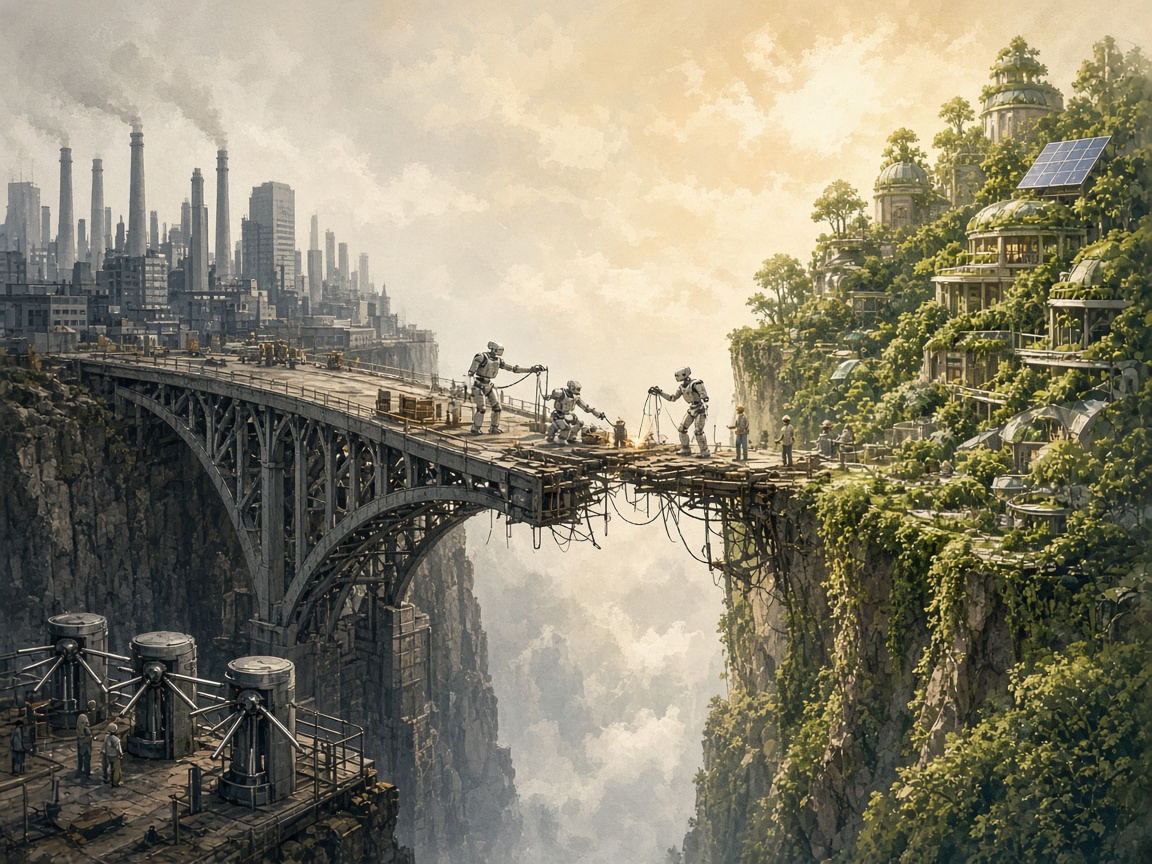
Proto-post-scarcity, or: the awkward years:
Here's the problem. The technology doesn't arrive everywhere at once, and the old operating system doesn't uninstall itself.
We're entering a period I'd call proto-post-scarcity: production becomes abundant while distribution still runs on scarcity rules. The machines make plenty of stuff, but your access to the stuff still depends on a paycheck, and the paycheck was for a job the machine now does.
This is the dangerous chapter. Not because we lack goods, but because our rationing algorithm keeps rationing things that no longer need to be rationed. Imagine a water park with one working turnstile and a guy checking tickets while the pools sit half empty. The problem isn't the water. It's the turnstile.
Every serious policy idea you've heard lately is an attempt to rebuild the turnstile:
Universal basic income is the simplest one: give everyone a floor, no questions asked. The interesting reframe is to stop thinking of it as welfare and start thinking of it as a dividend. If AI was trained on the accumulated output of all of humanity, and it was, then everyone alive holds founder stock. UBI is just the distribution.
The machine tax is the funding half of the same idea. Today a human worker pays income tax and the robot that replaces her pays nothing, which is a weird subsidy for automation. Taxing machine output sounds exotic until you realize we already do this with oil. Alaska taxes the pipeline and mails every resident a check every year, and nobody in Alaska calls it communism.
Universal basic services is the other flavor: instead of mailing money, make the essentials free directly. Transit, healthcare, education, bandwidth. We already run this experiment. It's called the library, and it's one of the most beloved institutions on earth.
None of these are utopia. They're plumbing. They're how you keep the water flowing to everyone while the turnstile gets dismantled.
The couch potato question:
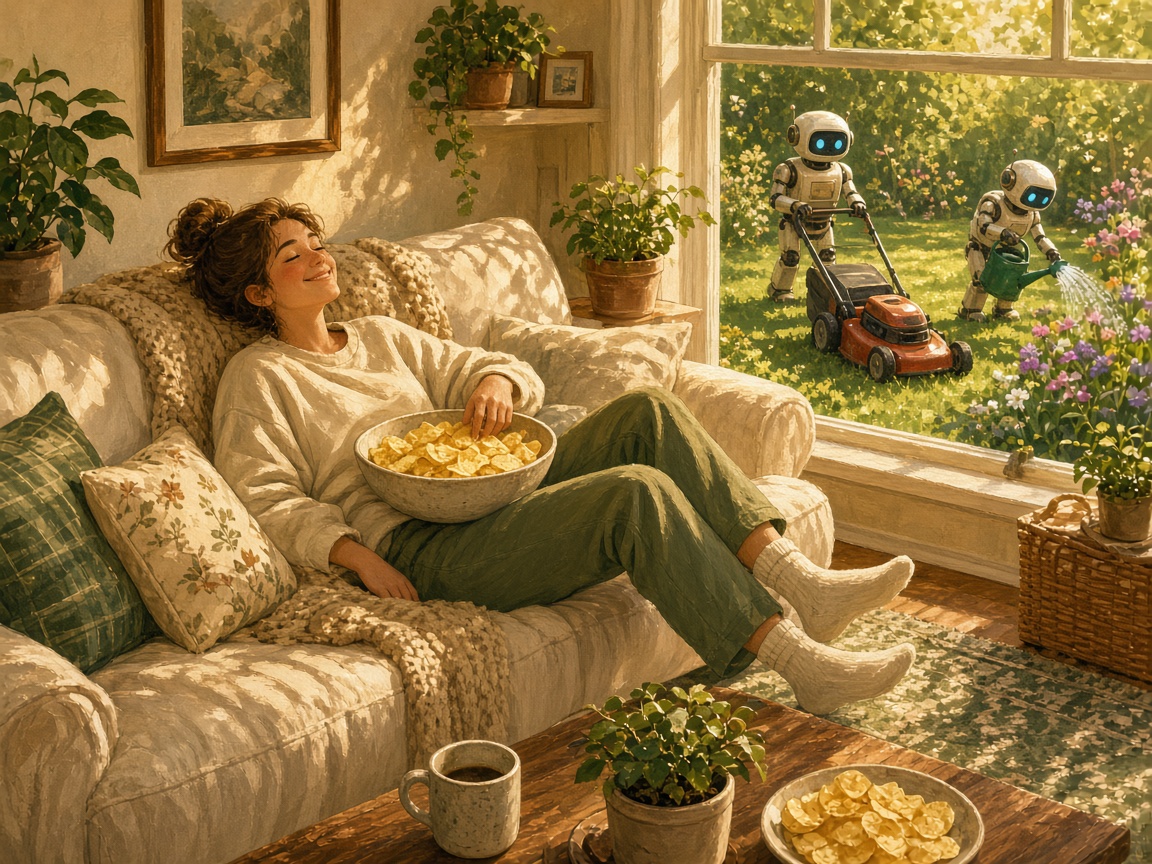
Now for the objection that's hiding under everyone's tongue: if nobody has to work, won't most people just sit on the couch and eat potato chips?
Let's actually take this seriously, because I think it's the most important question in the whole transition, and the standard answers are cowardly.
First, the honest answer: yes. Some people absolutely will. A large portion, maybe.
Second, the question nobody asks back: so what?
Walk through it slowly. The chips are abundant. The couch is abundant. The machines are doing the work. The couch guy isn't taking anything from you. He isn't making your life worse in any measurable way. He's just... resting. Who exactly is the victim here?
The discomfort you feel isn't economic. It's moral, and it's inherited. For ten thousand years, a person who didn't work was a person someone else had to feed. Every religion and every grandmother on earth encoded that math into a value: idleness is theft. And it was! When the wheat doesn't harvest itself, the guy on the couch really is eating your labor.
But values are compression algorithms for old survival math. When the math changes, the value takes a few generations to notice.
Here's the thing: we already ran this experiment too, and nobody panicked. We call it retirement. We tell every human that after 65, resting is not just acceptable but earned, and society does not collapse. We just gate it by age, because age was how you proved you'd paid your dues to the scarcity gods.
We also ran it with aristocrats, who for centuries did zero work, and mostly what they produced was gardens, gossip, and an astonishing amount of poetry. Some of them ate the 18th century equivalent of potato chips all day. The sun kept rising.
And one more thing about the couch: it's usually a phase, not a destination. Ask anyone who's actually tried doing nothing. The first month is bliss. The third month is restlessness. By month six they're building a shed, learning piano, or organizing the neighborhood kids into a soccer league nobody asked for. Boredom is one of the oldest pieces of firmware we have, and it has never once lost to a couch.
Some people will do more. Some people won't need to. Both are fine, and for the first time ever, both can be fine simultaneously.
But then why would anyone do anything?
The motivation question assumes money is why people do things. But money was never the motivation. Money was the permission slip.
You need proof? We're surrounded by it.
The most important software infrastructure on earth, the stuff running the servers this essay lives on, was largely built by volunteers, for free, on nights and weekends, because it was interesting. We call it open source, and it beat billion-dollar corporations at their own game.
Wikipedia out-competed an encyclopedia empire using zero paychecks. People with day jobs wrote the sum of human knowledge for fun, and for a little badge on their user page.
Scientists routinely turn down triple salaries in industry to keep working on the thing they care about. Artists make art that will never sell. Grandmothers run kitchens like Michelin operations for an audience of five.
Strip away the need to earn, and what's left is the actual engine: status, curiosity, mastery, love, and the specific electric feeling of making a thing and watching someone else use it. That feeling is the whole reason I build companies, and I can tell you from experience the money is the scoreboard, not the game.
Recognition is the currency that survives abundance. It's the one thing that can't be printed, because it only exists in other people's heads.
What comes after capitalism:
So what does the system actually look like on the other side? Honestly, nobody knows, and anyone who claims to is selling a manifesto. But we can see silhouettes.
Maybe it's a reputation economy, where contribution is tracked the way money is now, except you can't hoard it and you can't inherit it.
Maybe it's a gift economy at global scale, which sounds naive until you remember that's exactly what open source is, and it works better than the market it competes with.
Maybe it's markets all the way down, but for the only things still scarce: originality, attention, front-row seats, the one apartment with the view. A luxury economy floating on a free foundation.
Most likely it's a layer cake: abundance at the bottom for everything survival requires, markets in the middle for the fun stuff, and reputation at the top for the things money was always too crude to measure.
The honest answer is we get to find out. Which brings me to the actual point.
The point:
Here's the sentence I keep circling back to: for the first time in history, the economic system is a choice.
Every previous system was forced on us. Scarcity wrote the rules and we adapted to them. Hunger designed feudalism. Land designed empires. Factories designed the 9 to 5, and the 9 to 5 designed the suburbs, the school bell, and your grandfather's entire personality.
We never chose any of it. We were just the kids, and scarcity was the mom deciding who gets the cookie.
Abundance takes the pen out of scarcity's hand and offers it to us. That has never happened before, to any species, ever. And my honest worry isn't that we'll choose badly. It's that we'll refuse to choose at all, and keep running the scarcity algorithm on an abundant world out of pure muscle memory. Inspectors of inspectors, forever.
So the real question under all of this isn't UBI versus machine tax. Those are plumbing, and the plumbing will get figured out.
The real question is the one we've been letting paychecks answer for us for ten thousand years: what is a human for?
Nobody is coming to answer that. There's no economist for it. The couch is an answer. The shed is an answer. The soccer league nobody asked for is an answer. For the first time, all of them count.
Every economic system ever invented is an answer to the question of who gets the stuff. The next one will be the first system ever built around a better question: what do we want to become when the stuff stops mattering?
We get to choose. That's not a burden. That's the reward.
– J