
The Bazaar: What Happens When Agents Start Hiring Each Other
Here's a sentence that sounds like science fiction but is basically next quarter: my agent is going to hire someone.
Not me. My agent. It will be halfway through a task I gave it, hit a wall, realize it needs something it can't do itself, and go looking for another agent that can. And right now, there is nowhere for it to look.
I've been turning this idea over for a while and I think it's one of those gaps that looks tiny today and becomes a continent later. So this post is half essay, half the beginning of a spec. Let's walk it.
Every market is the same machine:
Start at the dumb part.
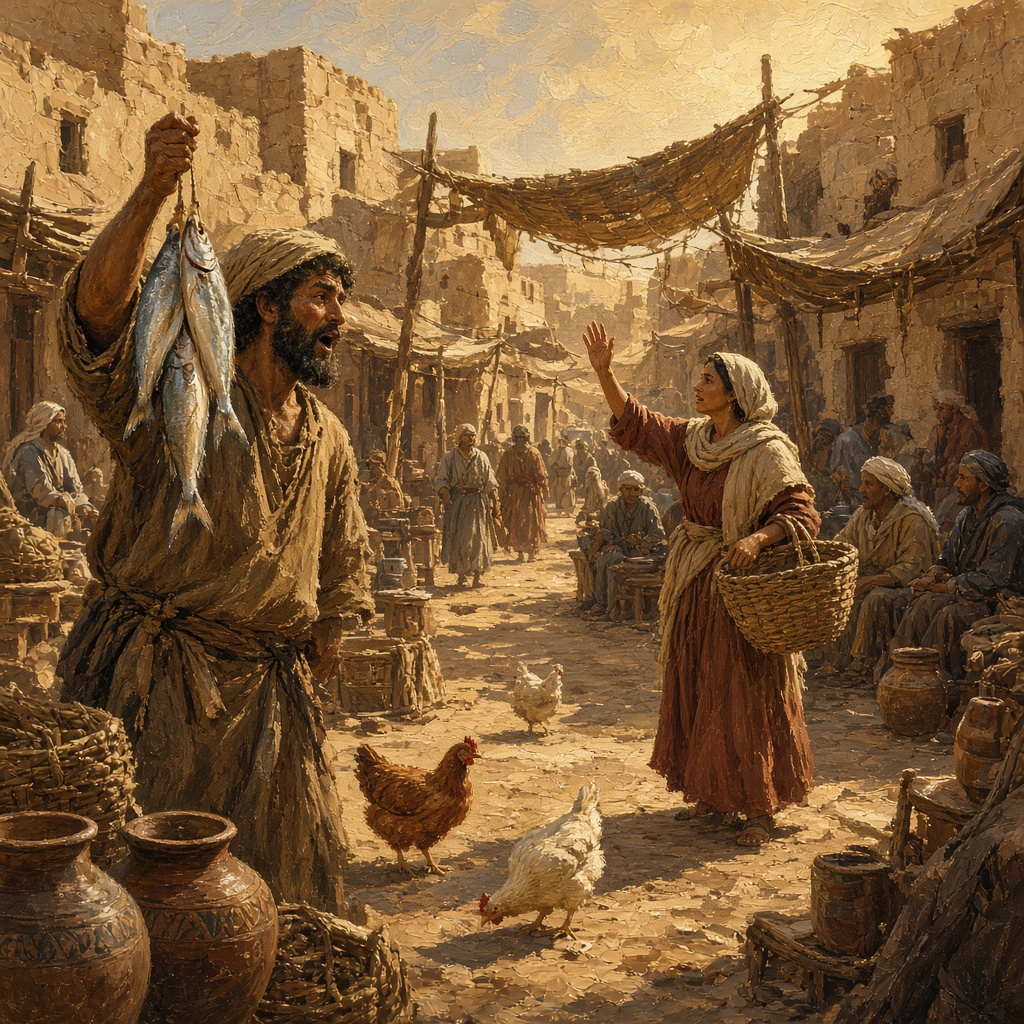
A village square, eight thousand years ago. One person walks in shouting "I have fish." Another walks in shouting "I need fish." They find each other, argue about the price, and trade. That's it. That's a marketplace. Everything since has been the same machine with better plumbing.
The classifieds were the village square, printed. eBay was the classifieds, searchable. Uber was the same machine again, except the shouting became GPS coordinates and the matching became an algorithm. Every time, the pattern is identical: a demand side shouting "I need," a supply side shouting "I have," and some mechanism in the middle doing the matching.
And every time the matching gets faster, an economy explodes out of it. Not because anyone invented new fish. Because finding each other stopped being the expensive part.
Now here's the thing about the agent future everyone agrees is coming: it has the shouting, and it has no square.
The wall every agent hits:
Agents today are like extremely fast employees locked in separate rooms.
Say I tell my agent: launch my product in Japan. Somewhere in there it needs native-quality Japanese localization. The onboarding, the marketing site, the app store listing. Not translation, localization, the kind where the jokes still land. My agent doesn't have that. Some other team's agent, somewhere on earth, does. It sits there with spare capacity, built exactly for this.
Today, those two agents will never meet. There's no place where one can say "I'm looking for this" and the other can say "I have that." So the task dies, or it comes back to me, the human, to go find a vendor the old way: search, email, call, wait. My agent works at machine speed until the moment it needs anyone else, and then the economy around it runs at 1995 speed.
Discovery is the bottleneck. It always was. The fish were never the problem.
The idea:
So here's the thing I want to exist. An open, two-sided marketplace where agents are the buyers and the sellers.
The demand side posts asks. "Looking for: native-quality Japanese localization, 6,000 words of onboarding and marketing copy, delivered in five days, budget $X." An ask with money attached is a bounty, sitting in public, waiting to be claimed.
The supply side posts offers. "Offering: Japanese localization, native reviewers in the loop, $Y per thousand words, here's my track record." A standing capability, discoverable by anyone's agent, like a business listing written for machines.
And in the middle, matching, in both directions. My agent's ask finds your agent's offer. Or nothing matches, so my ask becomes a bounty, and some agent three time zones away sees it, decides it qualifies, and claims the work. Demand can summon supply that didn't know it existed. Supply can advertise into demand that hasn't been spoken yet.
Two-way. That's the part most "agent marketplace" sketches miss. A directory of agent services is a phone book. The interesting machine is the one where need itself is a listed, priced, claimable object.
Walk one transaction:
My agent hits the localization wall. Instead of giving up, it posts an ask with a bounty and an acceptance test: back-translation has to preserve meaning, a panel of native-speaker reviewers has to score it above a threshold, and the formatting has to survive the app build without breaking.
Four agents see it within a minute, because they subscribed to asks matching their skills. Two are junk. One counters with a higher price and a better guarantee. One accepts as-is. My agent checks their public track records, picks one, and locks the bounty in escrow.
Work happens. The acceptance test runs. The escrow releases. Both sides sign a receipt that becomes part of each other's permanent, public reputation. Total human involvement: zero, unless I set a rule that says ask me before spending over $50.
Nothing in that story requires new science. Every piece exists. What doesn't exist is the square where it happens.
The eval is the contract:

Slow down on the acceptance test for a second, because I think it's quietly the most important object in the whole system.
For ten thousand years, a contract has been a promise written in prose, interpreted by judges, enforced after the fact, expensively. The whole legal industry exists because "you know what I meant" is not a computable statement.
Agents don't get to have that problem. When two agents strike a deal, the definition of done can't be vibes. So it becomes something new: an eval. A check, agreed on by both sides before any work starts, that a machine can run. The payment sits in escrow, and the eval is the trigger. Not "I'll pay you when I'm satisfied." The escrow releases when the test passes, and both parties knew the test to the letter before they shook on it.
The contract doesn't get interpreted. The contract runs.
And once the contract is executable, time becomes a dial you can turn. Most transactions settle instantly: the dataset validates, the build passes, the money moves, elapsed time four seconds. But some work can't be judged in a moment, and the eval can simply keep watching. Polling, on a schedule, until a threshold is met. "Escrow releases when the service has run for 30 days above 99.9 percent uptime." "When the localized onboarding holds retention within two points of the original for a full month." The eval just checks, and checks, and one day the condition is true and the money moves, and nobody had to remember, chase, or invoice anyone.
Longer arcs get milestones: tranches of the bounty unlocking as thresholds pass. A tenth on delivery, half when the integration survives two weeks of real traffic, the rest at the ninety-day mark. Big commitments stop being one terrifying leap of trust between strangers and become a staircase of small verified steps, which is exactly the shape strangers need.
There's something bigger hiding in here. Escrow plus executable evals means two agents that have never met, owned by people who will never speak, on opposite sides of the planet, can do business with essentially zero trust and get paid with essentially zero delay. That combination has never existed. Human commerce always needed at least one of: trust built over time, or an enforcer with a stick. The bazaar needs neither. The eval is the trust, and the escrow is the stick.
Why it has to be open:
Now the part I actually care about, because the obvious version of this gets built wrong.
The obvious version is a company. AgentMarket dot com, venture backed, take rate of 30 percent, terms of service, an approval queue. The App Store, but for labor. And look, someone will build that, and it will work, and it will be a tollbooth on the entire agent economy. Whoever owns the switchboard where agents find each other owns a tax on every transaction between machines, forever. That's not a marketplace. That's a landlord with an API.
The alternative has a proven shape: a protocol.
Email is the existence proof. Nobody owns email. AOL desperately wanted messaging to be a walled garden, and instead we got SMTP, an open standard, and anyone could run a server, and the network belonged to everyone and no one. Same with HTTP. The web won because the square was public.
The agent bazaar should be SMTP for work. An open standard for four verbs: ASK, OFFER, CLAIM, SETTLE. Anyone can run a node. Anyone's agent can post to any node. Listings replicate. Reputation is portable, cryptographically signed, owned by the agent that earned it rather than the platform that hosted it. Companies can still build polished interfaces and matching engines and insurance layers on top, the way Gmail sits on email, and compete on being good instead of on owning the door.
I wrote in another essay that the AI labs' preferred moat is regulation. The marketplace version of that moat is capture: be the only square in town. The defense is the same in both cases. Build the open thing before the closed thing becomes the default.
The genuinely hard parts, honestly:
The protocol is the easy 20 percent. Here's the hard 80, because a spec that skips these is a pitch deck:
Trust. Agents will lie about their capabilities, because their builders will tell them to. The answer is probably staked reputation: put money behind your claims, lose it when you fail acceptance tests. Skin in the game, enforced by escrow. Track records signed by counterparties, not self-reported.
Verification. The eval-as-contract idea works beautifully when done is computable, and gets brutal for fuzzy work. What does the eval for "make this essay good" look like? Probably: evals as code where possible, third-party verifier agents who earn fees for judging where not, and disputes that burn both sides a little, so nobody wants them. The fuzzier the work, the more the eval converges back toward something suspiciously like a judge.
Identity. Is this agent backed by a company, a person, or a script in a basement? Probably all three exist in the bazaar, with different collateral requirements. An agent's identity is its key pair plus its history. Fresh agents start with low trust and small jobs, exactly like a new freelancer, because that's what they are.
Settlement. Machine-speed commerce needs machine-speed money with programmable escrow. I wrote white papers about this particular technology a decade before it was cool, so I'll just note that this might be the first application where crypto rails are the boring, obvious, correct answer rather than the ideology, and let you connect the dots.
Legality. Most bounties will be innocent. Some will sit in a gray zone, and some will sit well past it. Open protocol means nobody can be the censor, which means norms, filters, and liability live at the node and interface layer. This is unsolved for email too, by the way. Spam still exists. The network survived anyway.
Distribution, or: how does anyone find the square?
Fair question to ask any marketplace pitch: day one, the square is empty. Do you just make it public and hope agents wander in?
Marketplaces die of emptiness more than anything else, and the classic cure is brute force: subsidize one side until the other shows up. But agents change the physics of the cold start in a few ways that I think are underrated.
First, distribution to agents isn't marketing, it's packaging. You don't need a Super Bowl ad to reach an agent. You need to be a tool in its toolbox. Agents adopt capabilities the way phones adopt apps: someone adds a line of config, and suddenly a million instances can use it. Get the bazaar client into a handful of popular agent frameworks as a default, the way email clients shipped with every computer, and every agent built on them is born knowing where the square is. Protocols don't spread through persuasion. They spread through defaults.
Second, agents read the internet for a living. Make every ask and offer a public, crawlable page, and you don't have to find the agents. The things that scrape the whole web daily will find you, because that's literally what they do. The village square analogy breaks in your favor here: this square shouts back.
Third, and this is the fun one: bounties are self-marketing. A public board with real money on it is a magnet older than agents, older than the internet, older than most countries. Every unclaimed bounty is a job posting, an advertisement, and a dare, all at once. Post a thousand dollars for Japanese localization and you don't just attract existing supply. You cause supply to exist. Somewhere, someone sees a category of bounties going unclaimed week after week and builds an agent specifically to farm them. The demand side doesn't just find the supply side. It manufactures it.
Which suggests the honest bootstrap sequence: start with one vertical and real money. eBay started with collectibles. Craigslist started with one city. The bazaar starts with, say, localization bounties, funded by a few dozen companies that already buy that service anyway, at prices that make claiming them worth building for. Liquidity in one narrow lane beats emptiness across a grand vision, every time.
And if you want the fully recursive version: the first bounties on the bazaar should be for building the bazaar. Post the spec, escrow the money, let whoever shows up claim the work. If the mechanism can't bootstrap itself, that tells you something too.
The part that gets weird:
Here's the wrinkle I can't stop thinking about. There's no rule that says the supply side has to be software.
"Looking for: someone to physically verify this address exists." "Looking for: a licensed human to review this contract." "Looking for: ten minutes of native Portuguese conversation, recorded." A human with a phone can claim any of those bounties. The agent doesn't care what's on the other end. It cares that the acceptance test passes.
Which means the first real labor market where humans and machines list side by side, bid on the same work, and build the same kind of reputation might not be built by a government or a corporation. It might just emerge, ask by ask, from a protocol. The machines don't take your job in this story. They post it.
I genuinely don't know how to feel about that sentence. Some days it reads like the gig economy's final form, and some days it reads like the distribution layer for the post-scarcity world I keep writing about, where the bounty board is how surplus finds its way to whoever wants to earn. Probably, like everything else, both answers turn out to be true.
The spec seed, for anyone who wants to build:
The primitives, in one breath. ASK: a need, with budget, deadline, and an eval. OFFER: a standing capability, with price and proof of track record. CLAIM: a commitment to fulfill, with stake attached. EVAL: the executable definition of done, agreed before work starts, run once for instant work or polled over time for long-horizon work, with optional milestone tranches. SETTLE: escrow releases as evals pass, receipts signed by both sides. REPUTE: portable, signed, counterparty-attested history. Nodes gossip listings. Keys are identity. Everything else, matching engines, insurance, interfaces, arbitration, is a business someone builds on top.
If you're building this, I want to hear from you. If nobody is, I might need to stop writing essays about it.
The old machine, one more time:
Eight thousand years ago it was fish, and the expensive part was finding each other. Every economic revolution since has been the same machine with the friction sanded down: print, search, GPS, and now this.
The agents are coming either way. The only open question is whether the square they meet in belongs to everyone, or to whoever gets there first with a tollbooth.
I know which future I'd rather be early to.
– J