The Reputation Economy: Money You Can't Keep
In After Money I threw out a line and didn't think twice about it, until several people told me it was the sentence that stuck with them:
"Maybe it's a reputation economy, where contribution is tracked the way money is now, except you can't hoard it and you can't inherit it."
It's been sitting in my head ever since. Because it's easy to say "reputation economy" and gesture at the future. It's harder to answer the obvious next questions: what would that actually look like on a Tuesday? Who keeps score? What stops it from becoming a Black Mirror episode?
So let's do the harder thing. Let's actually build it on paper and see if it stands up.
We already had this economy once:
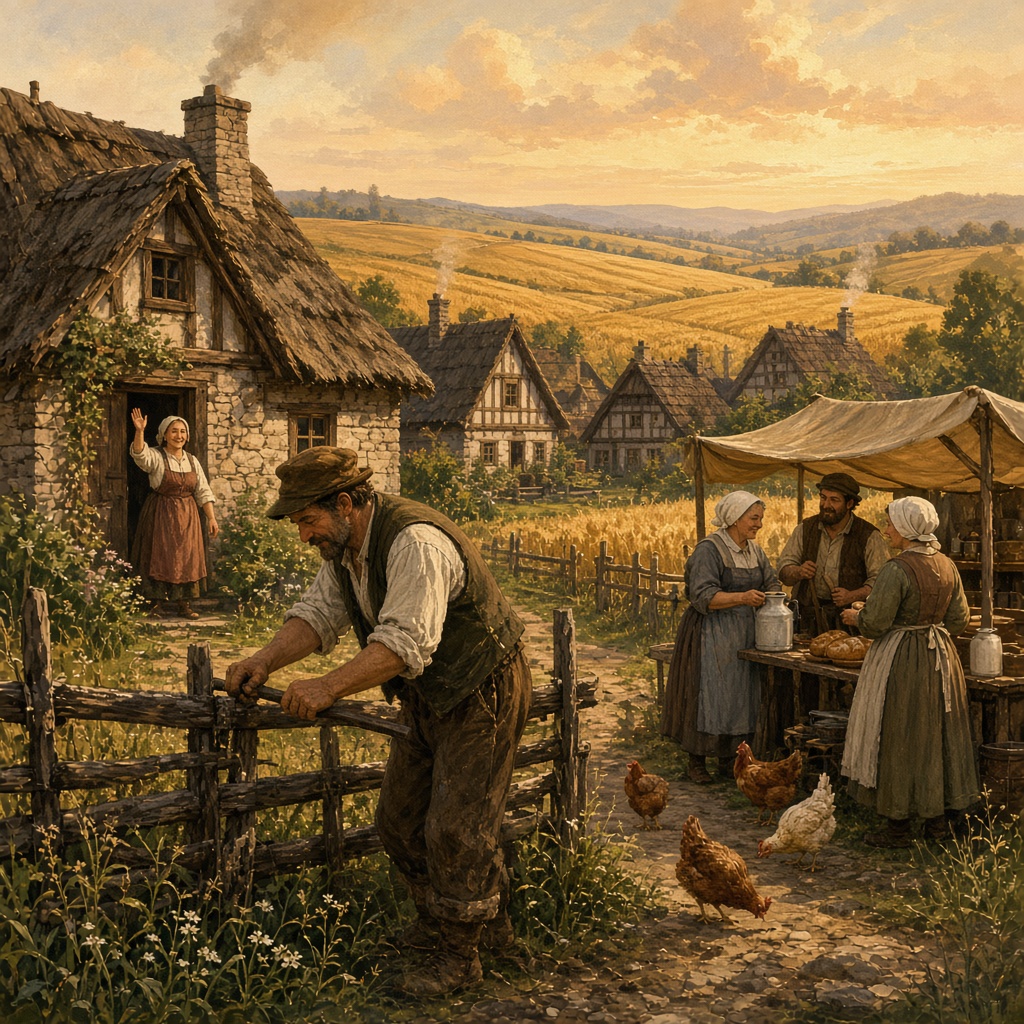
Here's the part that makes this less crazy than it sounds: reputation isn't the futuristic currency. It's the original one.
For most of human history, you lived in a village of maybe 150 people, and everyone knew everything. Who fixed the fence without being asked. Whose scales were rigged. Whose word held and whose didn't. Your reputation determined what you could borrow, who would trade with you, who would marry you, and whether the village pulled you out of a hole or left you in it. It was a complete economic operating system, and it ran for a hundred thousand years without a single bank.
It had exactly one flaw: it didn't scale. Reputation lived in people's heads, and heads only hold about 150 relationships. The moment you wanted to trade with a stranger two valleys over, reputation was useless. He didn't know you fixed the fence.
Money is the technology we invented to patch that flaw. A coin is trust you can hand to a stranger. It compresses "this person contributed something somewhere, probably" into a physical token that works between people who will never know each other. It's brilliant. It's also incredibly lossy. The coin doesn't say what you contributed, or whether it was good, or whether you got it by building something or by inheriting it from a grandfather who took it at swordpoint.
So look at what actually happened: we didn't choose money over reputation because money was better. We chose it because reputation couldn't scale and money could.
Which means the interesting question is sitting right there: what happens when technology makes reputation scale?
The three properties that change everything:

A reputation currency isn't just money with a different name. It behaves differently in three ways, and each one quietly deletes a problem we've been treating as permanent.
You can't hoard it. Reputation decays unless you keep earning it. Everyone already knows this instinctively: the phrase is "what have you done lately," and it applies to athletes, artists, and restaurants alike. Money sits in a vault compounding while you sleep. Reputation is a muscle, and muscles atrophy. Build that decay into the currency itself and wealth stops being a stockpile and becomes a flow. The only way to stay rich is to stay useful.
You can't inherit it. Your kids start at zero, the same zero everyone starts at. This is the radical one. The deepest bug in capitalism isn't that some people get rich, it's that capital compounds across generations, so the race gets decided before the runners are born. Reputation is mortal. It dies with the person who earned it. Every generation, the scoreboard resets and the whole game starts fresh. Inequality can still exist, but it can't calcify into aristocracy, because aristocracy is just inherited scoreboards.
Giving it costs you nothing. This one is subtle but it might be my favorite. Money is zero-sum in the moment of exchange: whatever I pay you, I no longer have. But when I say "she did brilliant work," I've paid her in the only currency that matters here, and my own account didn't drop. Reputation is the first currency where the act of paying people creates value instead of moving it. An economy built on a non-zero-sum currency has a fundamentally different temperature than one built on a zero-sum one.
What a Tuesday looks like:
Concretely, then. It's Tuesday in the reputation economy. What's different?
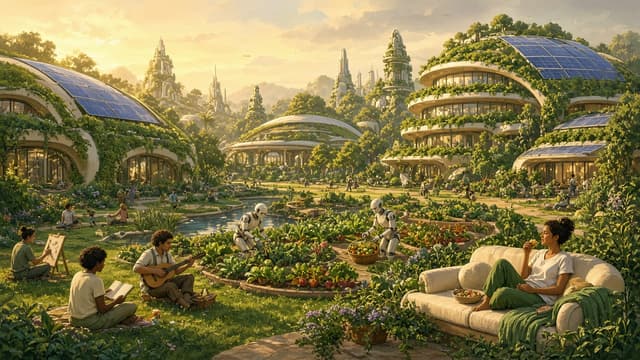
The bottom layer of your life is the abundance layer from the last essay: food, housing, healthcare, education, transit. Free or near-free, produced by machines, gated by nothing. Reputation has no power here, and that's a design requirement, not a detail. The moment reputation gates survival, you've rebuilt the dystopia with extra steps. Reputation is for the layer above: the things that stay scarce no matter how good the robots get.
And some things do stay scarce. The front-row seat. The apartment with the view. Attention. Originality. A slot in the workshop of someone brilliant. The right to direct a big shared project, like a mission to Mars or the redesign of a city's waterfront. Somebody has to decide who gets those, and today the answer is "whoever has the most money," which increasingly means "whoever chose their parents well."
In a reputation economy, the answer becomes: the people who've contributed the most, lately, in the relevant domain. The person directing the waterfront redesign is someone with deep, recent, verified reputation in building things communities loved. Not the highest bidder. Not the loudest voice. The best track record, as attested by the people who lived with the results.
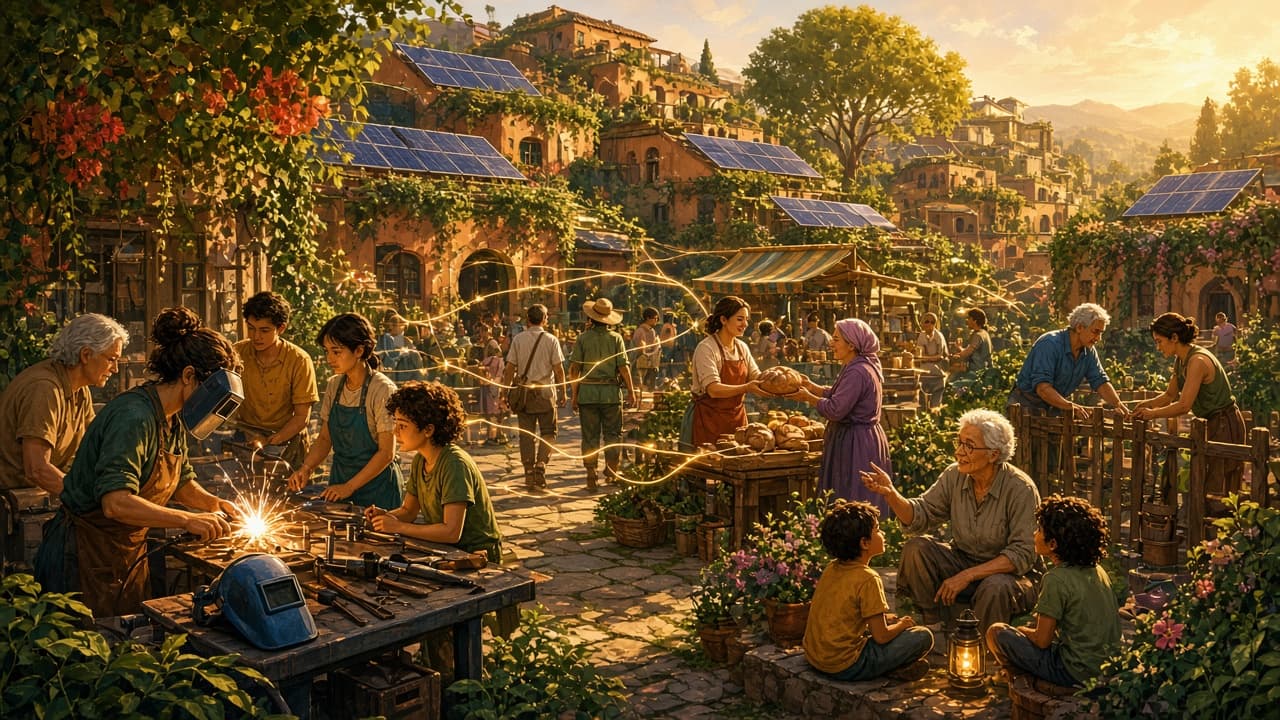
You'd carry something like a contribution graph instead of a bank balance. You taught forty kids to weld and eleven of them attested it changed their trajectory. You maintained a piece of open infrastructure through three brutal years. You cared for your neighbor through her chemo, and her family said so, on the record. None of this is a number on a leaderboard. It's a living history of what you did and who it mattered to.
How you'd actually build it:
Now the engineering, because this is where every previous attempt died.
The atomic unit is the attestation: a signed receipt from the person affected by your contribution. Not a five-star rating from a stranger, not a self-reported resume line. The student attests the teaching. The town attests the waterfront. The receipt is signed by the beneficiary, timestamped, and attached to both parties permanently. If that primitive sounds familiar, it's because it's exactly how I described agents building trust in the bazaar essay: reputation written only by counterparties, never by yourself. Turns out humans and machines need the same primitive.
Decay is a half-life, tuned per domain. Surgical reputation should decay fast, because surgery is perishable. Reputation for having written a great book can decay slowly. But everything decays, because the decay is the anti-hoarding mechanism. The math already exists; economists have toyed with decaying money for a century under the name demurrage. It never caught on for money because savers rioted. Reputation decays naturally anyway; we'd just be making the scoreboard honest about it.
It's a vector, not a scalar. This is the single most important design decision, so let me lean on it. The Black Mirror episode, and the Chinese social credit system, share one fatal design choice: one number, issued by one authority, spendable everywhere. That's not a reputation economy, that's a monarchy with a dashboard. Done right, reputation is domain-scoped: your standing as a builder, as a teacher, as a caregiver, as a neighbor, all separate. The brilliant surgeon gets no extra votes on city planning. There is no single number to optimize, no single ladder to climb, and no single lever for a tyrant to pull.
It's non-transferable, period. You can't buy it, sell it, lend it, or will it to your children. Attached to your identity, dies with your identity. The moment reputation becomes transferable, it becomes money, hoarding returns, inheritance returns, and the whole point evaporates.
And attestations are weighted by the reputation of the attestor, in that same domain. A master welder's attestation of your welding counts more than your mom's. If that sounds like PageRank for people, it's because it is: Google spent decades learning how to rank pages by weighted incoming links while adversaries attacked the system daily. The algorithms for this are old and battle-tested. Nobody has pointed them at contribution because there was no reason to. The reason is arriving.
The honest problems:
I'd rather list these myself than pretend a commenter won't.
Goodhart's law is the big one: any measure that becomes a target stops being a good measure. People will farm attestations, form mutual admiration rings, and perform contribution for the cameras. The defenses are real but partial: weighted attestors, decay (a farmed spike evaporates), domain scoping, and costly signals. It will still be gamed at the margins. So is money, whose margins include entire industries. The question is never "can it be gamed" but "does gaming it cost more than contributing," and that's a tunable parameter, not a fate.
Unmeasured work is the moral one. The mother of the disabled child. The person who talks a friend off a ledge at 3am and never mentions it. Some of the most important human contribution is invisible precisely because it's intimate, and a system that only rewards attested work will underprice it, exactly like GDP does today. Partial answer: attestations from families and neighbors, deliberately generous weighting for care domains. Honest answer: some things should stay outside every economy, and knowing which things is wisdom no algorithm supplies.
The grandmother problem: decay feels cruel at the end of a life. She built things for fifty years; at ninety she can't out-contribute a twenty-five-year-old, and shouldn't have to. I think the fix is an old one: separate honor from purchasing power. Honor is permanent, non-spendable, and cumulative. It's the hall of fame. Reputation, the spendable kind that allocates scarce things, decays. Every healthy institution that's lasted, from militaries to universities to churches, already draws exactly this line between the emeritus and the active. We'd just be drawing it on purpose.
And privacy. A full contribution graph is a full life record, which is radioactive. It has to be selectively disclosable, owned by the person and not a platform, provable without being public. The cryptography for that exists today and mostly gets used to trade monkey pictures. It's waiting for a better job.
Every economy runs on a vice:
Here's the frame that convinced me this is worth taking seriously.
Capitalism's genius was never markets. It was moral jiu-jitsu: it took greed, the most reliable vice we have, and pointed it at production. The baker feeds you because he wants your coin. Adam Smith said it politely, but the mechanism is vice harnessed for output, and it worked better than every system that demanded virtue instead.
A reputation economy runs the same move on a different vice: vanity. The desire to matter, to be seen, to be somebody. It's every bit as bottomless as greed, and we know that because we've watched people spend decades chasing karma points, edit counts, follower numbers, and little green squares on a commit graph, for free. That energy currently gets burned making advertising platforms richer. Point it at contribution instead and you've harnessed the second great vice.
Greed built the world of stuff. Vanity, properly plumbed, might build the world after stuff.
The part we don't have to wait for:
One last thing, and it's the reason this isn't just science fiction: the fragments already exist. Open source commit histories. Stack Overflow karma. eBay seller scores. Academic citations. Michelin stars. Every one is a working reputation micro-economy, some of them decades old, all of them stuck inside a platform that owns the ledger and can delete you from your own track record.
So nobody has to design this from a blank page. The job is smaller and stranger: take the receipts out of the platforms and give them back to the people who earned them, add decay, scope the domains, and stop the scores from being bought. Everything on that list is an engineering problem, and I say that as a compliment. Engineering problems get solved.
In the last essay I said the real question is what a human is for, and that for the first time we get to choose the system instead of having scarcity choose it for us. This is me sketching one of the choices in enough detail to argue with. It's not the whole answer. But an economy where the only way to be wealthy is to have recently made someone's life better, where every child starts at the same zero, and where paying people costs you nothing?
I've heard worse pitches. I've funded worse pitches.
– J