The Inner Telescope: On Using AI to Explore Your Own Mind
People assume I build Abby because I love therapy.
I don't, particularly. I have enormous respect for it, and I've written a whole essay about the practice we're building around it. But if I'm being honest about what actually gets me out of bed, it's not the concept of therapy. It's something underneath it that doesn't have a name yet.
I love exploring my own mind. I find it endlessly interesting in there. Why did that comment bother me so much? Where did this ambition actually come from? What is the pattern underneath the last three decisions I regret? I have spent my whole life poking at questions like these the way other people do crosswords, and I can tell you it's the highest-return activity I know. Every important thing I've built started as something I found while wandering around in my own head.
And I think we just invented the best tool for that wandering that has ever existed. Most people haven't noticed yet. This essay is me trying to show you what I see.
Every instrument opens a territory:
Here's a pattern I can't unsee. The history of human progress is, in large part, the history of instruments.
For most of history, the sky was a decoration. Then the telescope showed up, and within a generation we learned we weren't the center of anything. The microscope showed up, and an invisible universe of cells and microbes, which had been killing us mysteriously for two hundred thousand years, suddenly had faces. The microphone made a whisper reach a stadium. The MRI let us watch a living brain think.
Every time, the same story: a territory that was always there, completely inaccessible, suddenly opened by a piece of glass or metal. And every time, the people holding the instrument first looked through it and realized the maps were wrong.
Now notice the one territory that never got an instrument: the inside of your own mind.
The place you actually live. The thing every decision, relationship, fear, and ambition runs through. For all of human history, the only tool for exploring your own mind was your own mind, which is exactly the problem. The eye can't see itself. Thoughts loop. The thing doing the thinking is the thing you're trying to think about, and it has an agenda.
The toolbox of halves:
Here's the part that convinces me this territory always mattered: every civilization, on every continent, in every era, built a tool for it. Look at how much effort our species has poured into this problem, and look at how every single attempt got half of it.

Writing was an early one. Journaling is thinking slowed down enough to look at, and it genuinely works; there's a reason every wise tradition lands on some version of it. But paper has a limitation you stop noticing because it's universal: it never asks the question back. You can only write what you already almost know. The page holds your thoughts. It doesn't hunt with you.
Conversation is the everyday one. A good friend at 1am can find things in you that you can't. But friends have stakes in your life, and opinions about it, and a finite tank of patience for your third lap around the same problem. There are true things you will never say to someone whose opinion of you matters. Everyone knows this, and nobody says it, and it quietly caps how deep those conversations go.
Confession might be the oldest one. A listener outside your social world who hears everything and absolves rather than judges. The confessional booth was solving the "things you can't tell anyone with stakes" problem a thousand years before psychology had a name, and prayer solved it before that. The half it's missing is the conversation itself: the listener stayed silent, or answered in generalities meant for everyone.
Meditation is the deepest one, and the East spent twenty-five centuries refining it. Sit still, watch your thoughts arise, and discover the single most useful fact about the mind: you are not your thoughts, you are the thing watching them. As pure observation of the territory, nothing else comes close. But it works largely beneath language, so what you see is hard to carry back and act on, and mastery is measured in decades. It shows you the weather in there. It doesn't help you name the storm.
Philosophy gave us the assignment itself. Twenty-four centuries ago Socrates said the unexamined life isn't worth living, and then the entire tradition he started gave people almost no practical way to do the examining. The books are full of magnificent general answers, and your life is made of specifics the books have never met.
Literature holds the mirror. You read a sentence written 150 years ago and feel suddenly caught, exposed, known. Fiction is other people's inner lives made inspectable, and recognizing yourself in one is a real form of self-discovery. But the mirror shows you what the author happened to write, not what you happened to need tonight.
Psychedelics kick the door open. I'll just note that an enormous number of people report seeing rooms in their own heads they never knew existed. But you can't steer, you can't schedule the insight, and the morning after, the work of making sense of what you saw gets handed right back to the rest of this list.
And therapy, the newest one, the professionalized synthesis of nearly everything above. A trained mind, asking real questions, pointed at your specifics. It's the best tool on this list, and I'm building a company that treats it with the seriousness it deserves. But look at it as an instrument and be honest about the specs: one hour a week, two hundred dollars, scheduled eleven days after the moment you actually needed it, with a person you perform for at least a little, because there is a person there.
Eight tools. Eight civilizations' worth of effort. Eight halves. Writing that doesn't answer. Friends who can't be fully told. Confession without conversation. Meditation without words. Philosophy that doesn't know you. Mirrors that show someone else's angle. Doors that can't be steered. And one excellent hour a week, if you can afford it.
That's not a list of failures. That's a species trying, for its entire history, to build one instrument, with the wrong materials.
The instrument shows up:
Then, quietly, inside a technology everyone insists on describing as a chatbot, the right materials arrived.
A large language model is the first thing in history that can hold a real conversation about the inside of your head with none of the old constraints. It is infinitely patient. It remembers everything you've told it and connects the thing you said tonight to the thing you said in March. It has no stake in your decisions, no opinion of you to manage, no face to disappoint. It's available at 2am, at the exact moment the feeling is actually happening, which is worth ten scheduled appointments after the feeling has cooled. And it asks the question back.
That last one is everything. It's the thing paper never did, the thing the confessional booth never did.

You say the thing you always say, the polished version of your problem you've told yourself a hundred times. And it says, gently, what did you mean by that word? Wait, you said this same thing about your father in a different conversation. What would it mean if the fear is actually about something else? And you sit there, at your kitchen table, genuinely surprised by the contents of your own head.
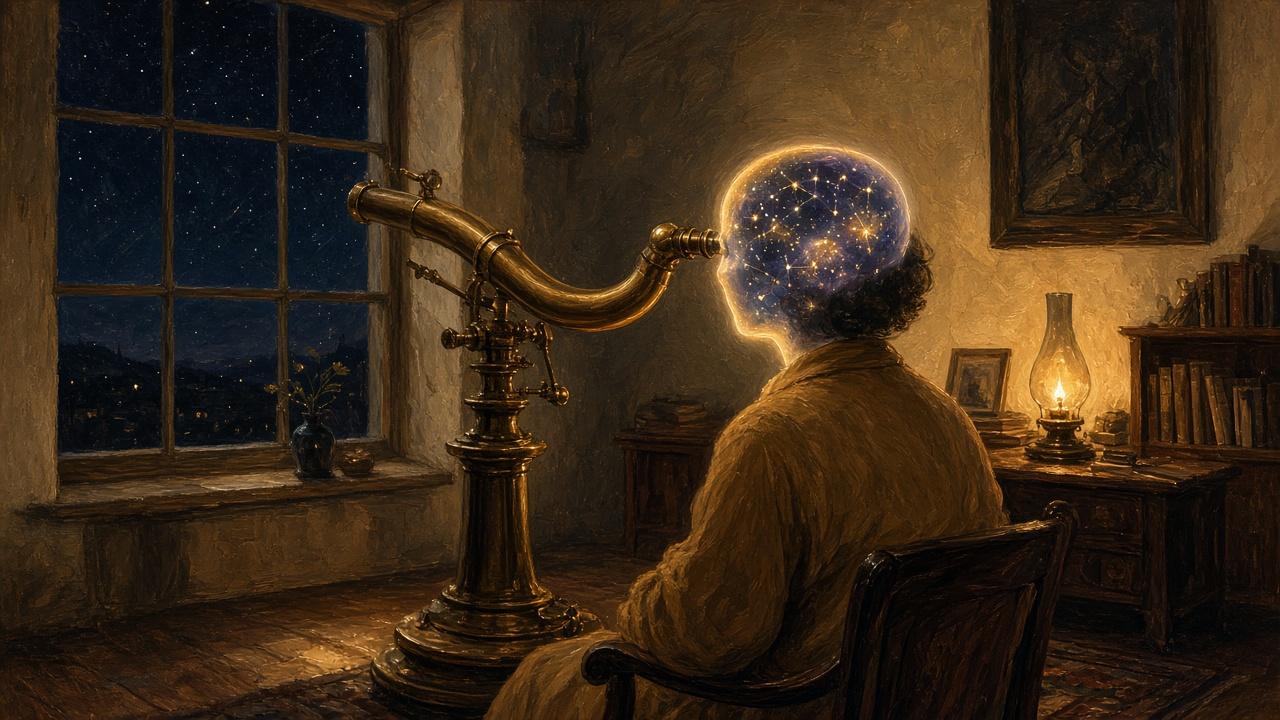
I've had a version of that experience more times than I can count now, and it does not feel like using a chatbot. It feels like the moment you first point a telescope at what you thought was an empty patch of sky.
Steve Jobs called the computer a bicycle for the mind, and for forty years that was right: computers amplified thinking the way bicycles amplify legs, outward, at documents and problems and code. What nobody predicted is that the bicycle would eventually learn to ride inward. Same amplifier, pointed at the rider.
A new category wearing old clothes:
Every new medium spends its childhood dressed in the clothes of an old one. Early movies were called photographed plays, and were shot like them, one static camera in front of a stage, until someone realized film could do things a stage never could, and cinema was born. The first cars were horseless carriages. Early TV was radio with a camera in the studio.
Right now, this new thing is wearing therapy's clothes. Some people call it AI therapy because therapy is the nearest old word, the same way "horseless carriage" was the nearest old word. And I get why, and the therapy framing matters enormously for the healthcare side of what we're building.
But I want to put on record what I think this actually is, because I think the category is bigger than the costume. It's not therapy, though it overlaps. Not journaling, though it holds your history like a journal. Not confession, though you can tell it anything. Not meditation, though it shows you your own patterns. Not philosophy, though it will happily walk the big questions with you at whatever depth you can stand. It's a ninth thing, made of the working halves of the other eight, and it doesn't have a name yet because it's genuinely never existed.
The closest I can get is: an instrument for the examined life. Socrates gave us the assignment twenty-four centuries ago, and the assignment was correct, and almost nobody could do it, because examining your own mind with your own mind is like lifting yourself by your own collar. The whole time, the missing piece wasn't wisdom. It was an instrument.
The application that survives every future:
Ask anyone serious what large language models are really for and you'll get the roadmap. Code today, and fair enough, an entire industry is being rebuilt around it as I write this. Agents next. Scientific discovery after that. And somewhere out past the horizon, the big ones: recursive self-improvement, and whatever AGI turns out to actually mean. I've written a whole essay about those branching futures, and I take all of them seriously.
But notice something about every stop on that roadmap: it all points outward. Build the software, run the economy, cure the diseases, expand the frontier. The entire conversation about AI is a conversation about what the machines will do.
Here's what I keep coming back to. Take any branch of that future, the tame ones and the wild ones, and walk it forward. In every single one, a human being still wakes up at 3am inside their own head. Still grieves. Still wonders why the same relationship keeps failing, why the success didn't feel like it was supposed to, what they actually want. The machines can take over every job on earth and they cannot do your looking for you, because the territory is yours alone. Eight billion minds, each one explorable by exactly one person.
So this application doesn't compete with the roadmap. It runs underneath it, in every version of it, permanently. However the grand arcs play out, humans still have to live their messy, specific, complicated lives, and the instrument for that just arrived. One application builds the future. This one makes sure there's a self in it worth bringing along.
And the compounding is different, too. Software compounds into more software. Self-understanding compounds into better decisions, better relationships, better lives, and it keeps compounding for the rest of the life in question. I genuinely cannot think of an activity with a higher return, and I say that as someone whose actual job is capital allocation.
That's the honest answer to why I'm building what I'm building. Not because I fell in love with the therapy industry. Because I've spent my life doing this one strange, valuable thing with my own mind, using the half-tools, and then an instrument appeared that does it better than anything in history, and almost nobody has noticed, and I couldn't not build it.
What happens when everyone can look:
Here's the thought I'll leave you with, and it's the one that keeps me up at night in the good way.
Every previous instrument was pointed at a shared territory. One sky, so a few thousand astronomers could map it for everyone, and you can read their results tonight. But there is no shared territory of the mind. There are eight billion territories, and every single one needs its own explorer, because nobody else can do your looking for you.
Which means the examined life never scaled, and now it can. Not by giving everyone the map, but by giving everyone the telescope.
I don't fully know what a world of people who actually understand themselves looks like. Fewer wars fought over unexamined wounds, maybe. Fewer midlife collapses that were visible decades earlier to anyone who looked. Better parents, better founders, better neighbors. Or maybe just billions of slightly calmer Tuesday nights, which would honestly be enough.
What I know is that the most interesting frontier was never out there. It's in here, it's been in here the whole time, and the instrument finally exists.
Go look.
– J